
St Anne'sChurch Primary School
Our Learning
Maths
'Sometimes the questions are complicated and the answers are simple.’
Dr Seuss
We want to ensure that every child leaves our primary school with a secure and deep understanding of mathematical concepts and principles and are confident in their application and reasoning, as well as fluent in the recall of basic mathematical facts.
Both our curriculum and pedagogical approach are driven by the National Curriculum 2014 for Mathematics, the aims of which are to ensure all pupils:
● Become fluent in the fundamentals of mathematics, including through varied and frequent practice with increasingly complex problems over time, so that children develop conceptual understanding and are able to recall and apply their knowledge rapidly and accurately to problems
● Reason mathematically by following a line of enquiry, conjecturing relationships and generalisations and developing an argument, justification or proof using mathematical language
● Can solve problems by applying their mathematics to a variety of routine and non-routine problems with increasing sophistication, including breaking down problems into a series of simpler steps and persevering in seeking solutions
Mastery Maths
Mastering maths means pupils acquiring a deep, long-term, secure and adaptable understanding of the subject. The phrase ‘teaching for mastery’ describes the elements of classroom practice and school organisation that combine to give pupils the best chances of mastering maths. Achieving mastery means acquiring a solid enough understanding of the maths that’s been taught to enable pupils to move on to more advanced material. The image below shows the five key elements of teaching for mastery.
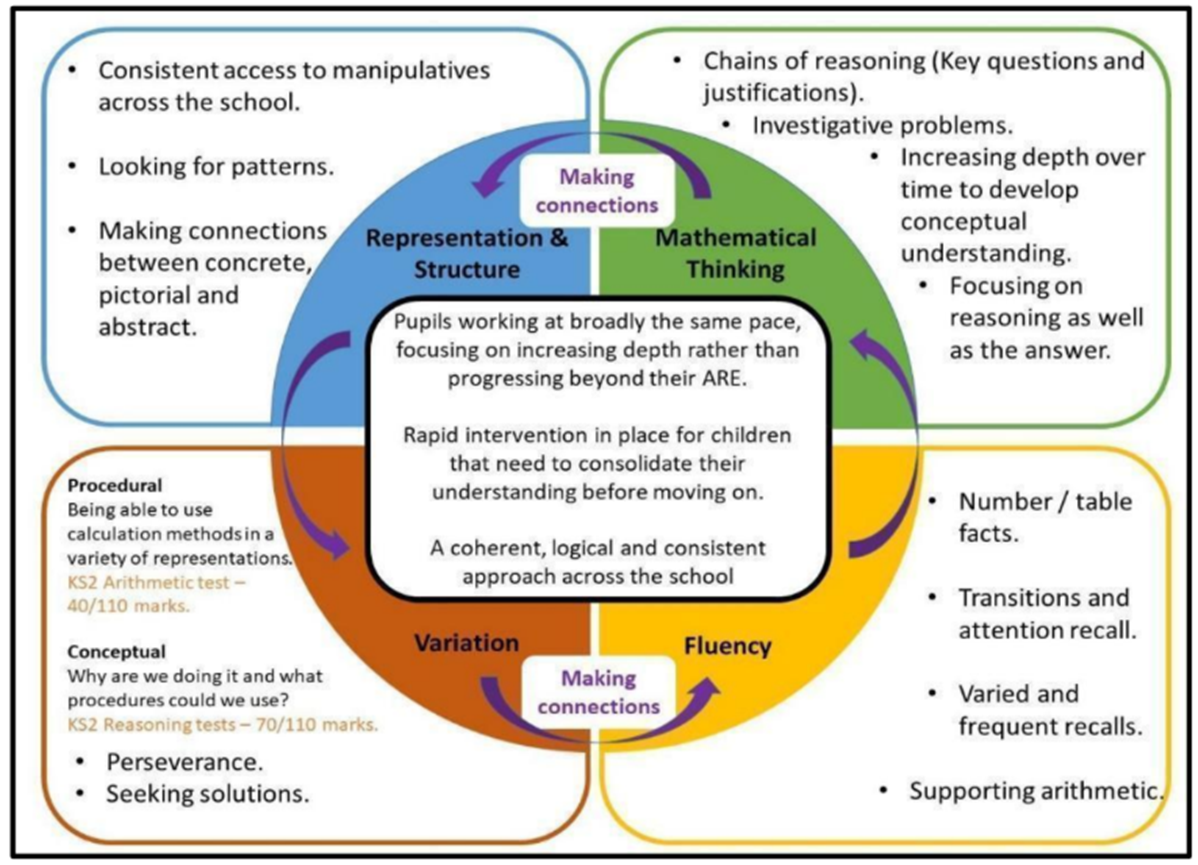
We have adopted the Curriculum Prioritisation approach in mathematics from the National Centre for Excellence in the Teaching of Mathematics (NCETM), alongside Mastering Number - a research-based initiative. In all year groups, a range of manipulatives are used to ensure children can work practically with number concepts before moving on to pictorial and abstract representations.
Misconceptions are planned for, and children are encouraged to make links between the different mathematical concepts they learn. Mathematical oracy sits at the heart of our teaching and learning; early on, children are taught and encouraged to use correct mathematical terms and are given opportunities to learn and hone skills in ‘maths talk’. This ensures children achieve a deeper understanding of how they approach mathematics, instead of simply concentrating on ‘getting answers right’.
Supporting your child at home in mathematics
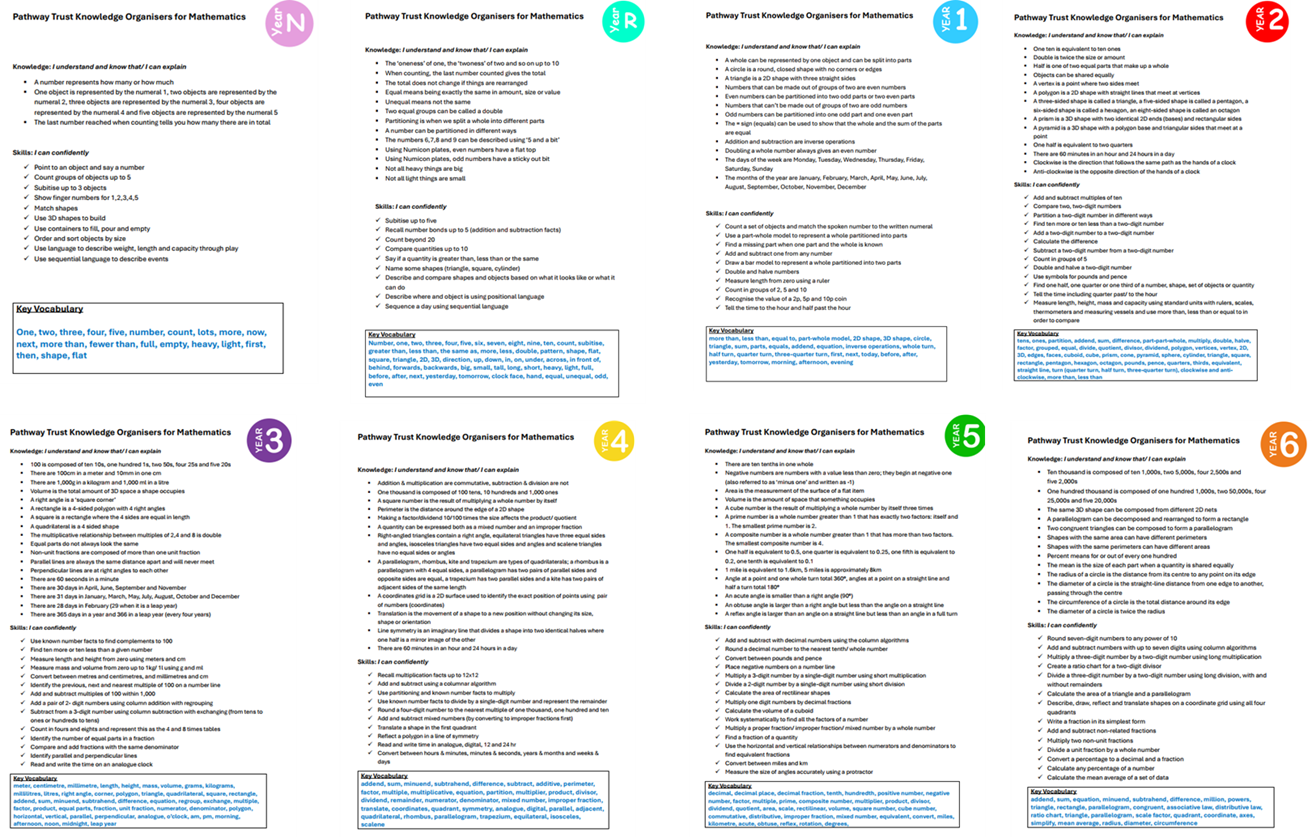
Below are our knowledge organisers for each year group from Nursery to Year 6. You can download the PDF documents at the bottom of the page. Find out what knowledge and skills children will have acquired by the time they leave each individual class.
| Useful Links |
|---|


